Progress of Theoretical and Experimental Physics, (2024 IF:8.3)
DOI: https://doi.org/10.1093/ptep/ptag01
Abstract
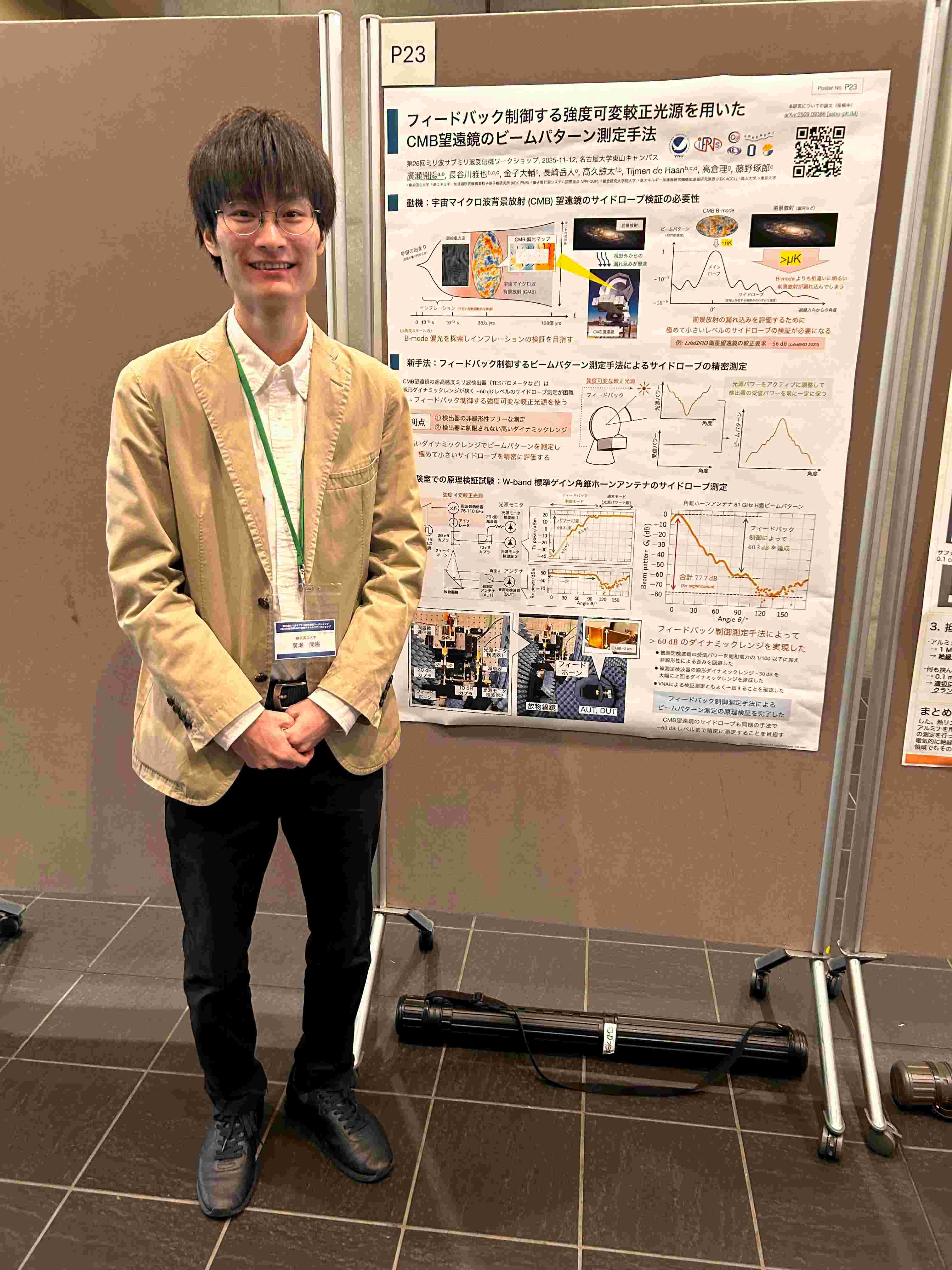
We demonstrate a novel beam pattern measurement method for the side lobe characterization of cosmic microwave background telescopes. The method employs a power-variable artificial microwave source under feedback control from the detector under test on the telescope. It enables us to extend the dynamic range of the beam pattern measurement without introducing nonlinearity effects from the detector. We conducted a laboratory-based proof-of-concept experiment, measuring the H-plane beam pattern of a horn antenna coupled to a diode detector at 81 GHz. We gained an additional dynamic range of 60.3 dB attributed to the feedback control. In addition, we verified the measurement by comparing it with other reference measurements obtained using conventional methods. The method is also applicable to general optical measurements requiring a high dynamic range to detect subtle nonidealities in the characteristics of optical devices.
Published Paper (2025/10/27)
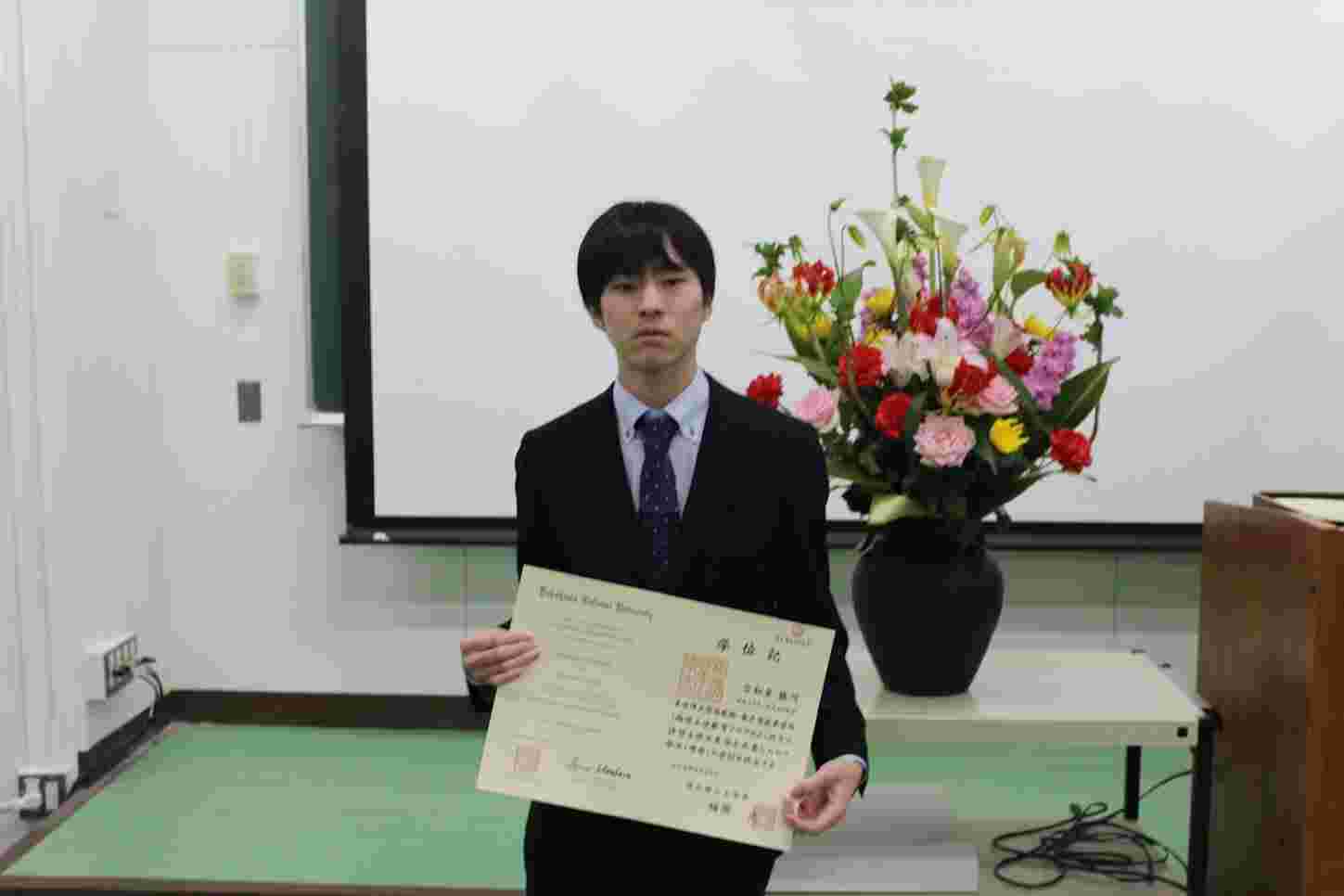
Okukawa, who earned his Ph.D. in June, has published his research as a peer-reviewed paper.
"Experimental Verification of a Convolutional Neural Network Separation Method in TeV Gamma-Ray Observations by the Tibet ASγ Experiment"
M. Amenomori et al.(Tibet ASγCollaboration)
Progress of Theoretical and Experimental Physics, Volume 2025, Issue 10, October 2025,103F01 (2024 IF:8.3)
DOI: https://doi.org/10.1093/ptep/ptaf127
Abstract
Since 1990, the Tibet ASgamma experiment has been observing gamma rays and cosmic rays with energies greater than several TeV using a surface air shower array.
An underground muon detector (MD) array operating since 2014 enables us to significantly discriminate between gamma rays and cosmic rays by counting the number of muons in the air showers.
However, discrimination with only the air shower array is challenging. We developed a convolutional neural network (CNN)-based method to improve the sensitivity of gamma-ray measurement data
recorded by only the air shower array.
The area-under-the-curve values of the CNN method for gamma rays generated by a Monte Carlo (MC) simulation assuming a gamma-ray source (Crab Nebula)
were 0.75 at 10 TeV and 0.83 at 100 TeV. The detection significances of gamma rays were improved by factors of 1.232 +- 0.007 at 10 TeV and 1.557 +-0.022 at 100 TeV.
For verification, we applied the proposed method to experimental data including high-purity gamma-ray-like events in the direction of the Crab Nebula, acquired using both arrays.
The distributions of gamma-ray-like properties obtained from the CNN were in good agreement with the MC Simulation, with reduced
values of 0.507-1.57, corresponding to an upper cumulative probability of 0.120-0.871.
Published Paper (2025/10/27)
Imaizumi, who conducted his graduation research in our lab in 2024, has published his research as a peer-reviewed paper.
"A Simulation Study on the Cosmic-Ray Energy Spectra of Elemental Mass Groups using the Tibet Air-Shower and Muon Detector Arrays through the Bayesian Unfolding Method"
G Imaizumi, M Anzorena, K Fujita, Y Katayose, S Kato, T Kawashima, K Kawata, A Mizuno, M Ohnishi, R Garcia, T Sako, F Sugimoto, M Takita, Y Yokoe
Progress of Theoretical and Experimental Physics, Volume 2025, Issue 10, October 2025, 103F02 (2024 IF:8.3)
DOI: https://doi.org/10.1093/ptep/ptaf133
Abstract
We study the analysis method to determine the cosmic-ray energy spectra of different mass groups assuming the use of the Tibet ASgamma
experiment, which consists of the high-density Tibet air-shower array and the underground muon detector array. These arrays measure the sampling air-shower size ("sum of rho")
and the total muon number of each air-shower event("sum of Nmu"). These parameters are known to contain information on the energy and mass of the primary particle.
To reconstruct the energy spectra of individual cosmic-ray mass groups, we apply a multidimensional unfolding method based on Bayes’ theorem to the 2D distribution of "sum of rho" and
"sum of Nmu"
produced by Monte Carlo simulation. Simulated datasets with combinations of the EPOS-LHC, SIBYLL-2.3c, and QGSJET II-04 high-energy hadronic interaction models
and a helium-dominant composition model are analyzed while using a response matrix produced by EPOS-LHC.
The unfolded spectra of the EPOS + helium-dominant composition model dataset show a deviation from the input flux within
+-10% except for a few bins, meaning that the uncertainty of the technique itself and the composition model dependence is at that level.
It is also shown that the deviation in the all-particle spectrum is within +-10 % even when using different hadronic interaction models in the dataset and the response matrix.
On the other hand, the unfolded spectra of individual mass groups have a clear dependence on the hadronic interaction model.
The model dependence of the proton and helium spectra amounts to +-25% below 10^6.5 GeV.
The dependence in the carbon group is at a +-25 %level below 10^6 GeV, and for the iron spectrum, it amounts to +55 % and -30 % in the energy range of 10^5.1 GeV to 10^6.7 GeV.
We are now able to measure individual energy spectra in the knee region—including those of heavy nuclei, which remain poorly understood. Thanks to the recent extension of direct measurements beyond 10^4 GeV,
a comparison between our analysis and the direct measurements will provide a good test of the hadronic interaction models.
Published Paper (2024/4)
Okukawa, a doctoral student in our lab., has published his research findings as a peer-reviewed paper.
"Neural networks for separation of cosmic gamma rays and hadronic cosmic rays in air shower observation with a large area surface detector array"
The Tibet ASγ experiment has been observing cosmic gamma rays and cosmic rays in the energy range from teraelectron volts to several tens of petaelectron volts with a surface detector array since 1990. The derivation of cosmic gamma-ray flux is made by finding the excess distribution of the arrival direction of air showers above background cosmic rays. In 2014, the underground water Cherenkov muon detector (MD) was added to separate cosmic gamma rays from the background on the basis of the muon-less feature of the air showers of gamma-ray origin; hybrid observations using these two detectors were started at this time. In the present study, we developed methods to separate gamma-ray-induced air showers and hadronic cosmic-ray-induced ones using the measured particle number density distribution to improve the sensitivity of cosmic gamma-ray measurements using the Tibet air shower array data alone before the installation of the MD.
We tested two approaches based on neural networks. The first method used feature values representing the lateral spread of the secondary particles, and the second method used the shower image data. To compare the separation performance of each method, we analyzed Monte Carlo air shower events in the vertically incident direction with mono-initial-energy gamma rays and protons. When discriminated by a single feature, the feature with the highest separation performance has an area under the curve (AUC) value of 0.701 for a gamma-ray energy of 10 TeV and 0.808 for 100 TeV. A separation method with a multilayer perceptron (MLP) based on multiple features has AUC values of 0.761 for a gamma-ray energy of 10 TeV and 0.854 for 100 TeV, which represents an improvement of approximately 5% in the AUC value compared with the single-feature case. We also found that the feature values that effectively contribute to the separation vary depending on the energy. A separation method with a convolutional neural network (CNN) using the shower image data has AUC values of 0.781 for a gamma-ray energy of 10 TeV and 0.901 for 100 TeV, which are approximately 5% higher than those of the MLP method. We applied the CNN separation method to Monte Carlo gamma-ray and cosmic-ray events from the Crab Nebula in the energy range 10 100 TeV. The AUC values range from 0.753 to 0.879, and the significance of the observed gamma-ray excess is improved by 1.3 to 1.8 times compared with the case without the separation procedure.
Published Paper (2023/1)
Okukawa, a doctoral student in our lab., has published his research findings as a peer-reviewed paper.
"Hadronic interaction model dependence in cosmic Gamma-ray flux estimation using an extensive air shower array with a muon detector"
Observation techniques of high-energy gamma rays using air showers have remarkably progressed via the Tibet ASγ, HAWC, and LHAASO experiments. These observations have significantly contributed to gamma-ray astronomy in the northern sky’s sub-PeV region. Moreover, in the southern sky, the ALPACA experiment is underway at 4,740 m altitude on the Chacaltaya plateau in Bolivia. This experiment estimates the gamma-ray flux from the difference between the number of on-source and off-source events by real data, utilizing the gamma-ray detection efficiency calculated through Monte Carlo simulations, which in turn depends on the hadronic interaction models. Even though the number of cosmic-ray background events can be experimentally estimated, this model dependence affects the estimation of gamma-ray detection efficiency. However, previous reports have assumed that the model dependence is negligible and have not included it in the error of gamma-ray flux estimation.
Using ALPAQUITA, the prototype experiment of ALPACA, we quantitatively evaluated the model dependence on hadronic interaction models for the first time. We evaluate the model dependence on hadronic interactions as less than 3.6 % in the typical gamma-ray flux estimation performed by ALPAQUITA; this is negligible compared with other uncertainties such as energy scale uncertainty in the energy range from 6 to 300 TeV, which is dominated by the Monte Carlo statistics. This upper limit of 3.6 % model dependence is expected to apply to ALPACA.
Published Paper (2022/9)
Kurashige, who graduated in the 2021 academic year, has published the results of his master’s thesis as a peer-reviewed paper.
"Sensitivity of the large muon detector with the Tibet air shower array to measure the primary proton spectrum between 40 and 630 TeV"
Progress of Theoretical and Experimental Physics
D Kurashige, N Hotta, Y Katayose, K Kawata, M Ohnishi, T Saito, T K Sako, M Shibata, M Takita
The Tibet ASγ group has been continuously observing cosmic rays and cosmic gamma rays above several TeV using the muon detector array (MD) and high-density Tibet air-shower array (Tibet-III) installed on the Tibet plateau at an altitude of 4300 m. The MD is a water Cherenkov pool array with a large effective area of 3400 m2 and has an excellent capability of primary selection using the number of muons in the shower. We report the sensitivity of the proton spectrum measurements for energies 40–630 TeV obtained via Monte Carlo simulations for an air-shower experiment.
It was found that protons could be separated with a purity of 90%, and the survival ratio of protons including model dependence was 14.2%–19.1% and 3.7%–7.4% at about 35 TeV and about 450 TeV, respectively. The maximum total systematic error of the proton flux depending on interaction models in air-shower development and composition models was ±37%. With a large effective area and high proton separation capability, the Tibet ASγ experiment can measure the proton spectrum in the energy range from tens to hundreds of TeV with high statistical accuracy.
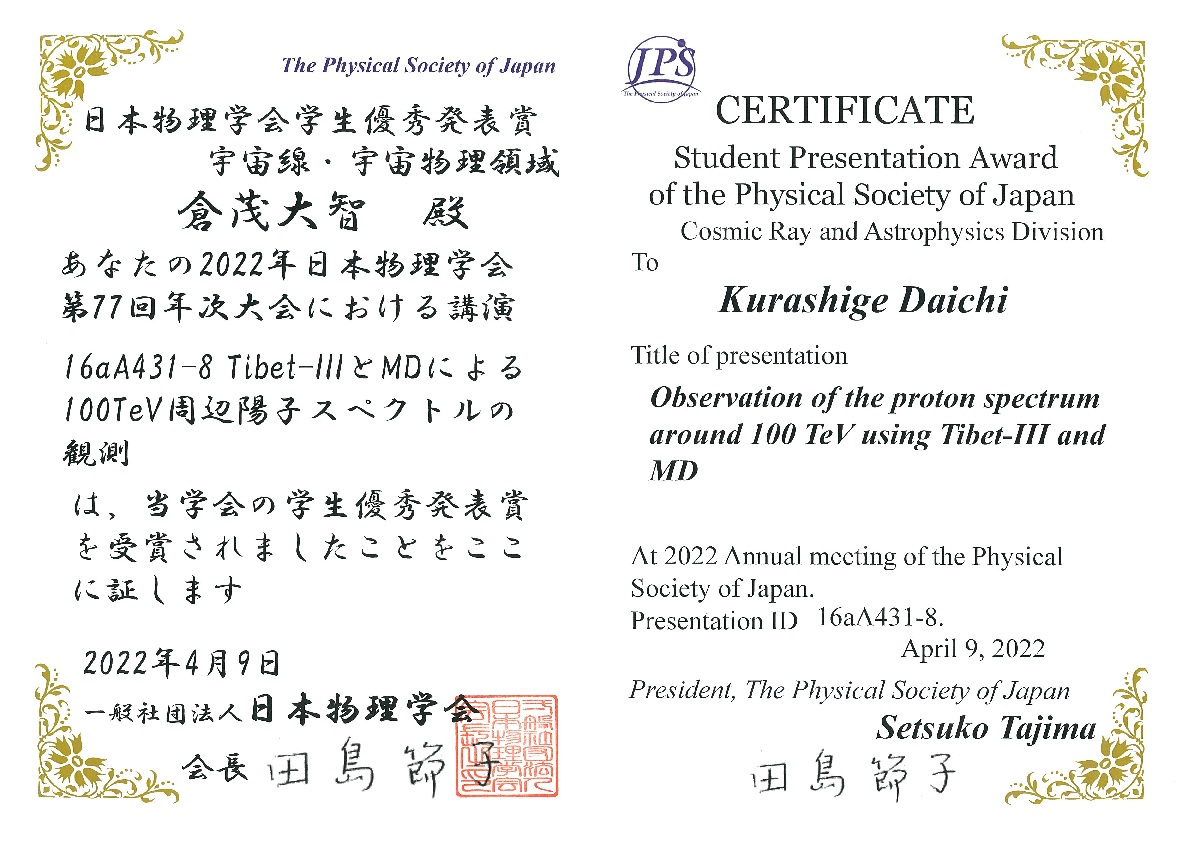
Student Presentation Award of the Physical Society of Japan (2022/4)
At the 2022 Annual Meeting of the Physical Society of Japan, held from March 15 to 19, 2022, Daichi Kurashige, a graduate of the class of 2021, received the Physical Society of Japan Student Award for Outstanding Presentation.
The title of the award-winning paper is “Observation of the Proton Spectrum Around 100 TeV Using Tibet-III and MD.”
For research on cosmic gamma rays with energies in the range of several tens of teraelectronvolts or more, we investigated a method to improve the angular resolution of an air shower. In an air shower, the density of secondary gamma rays is several times higher than that of electrons and those measurement is important for determining the shower direction. It was found that the angular resolution in the shower front-fit method decreases in inverse proportion to the square root of the number of measured particles. Even if the total number of measured particles is the same, secondary gamma rays contribute more to the improvement of angular resolution than electrons. If secondary gamma rays could be measured at an altitude of 4,740 m with a sensitivity of 100 %, an improvement of approximately 40 % was determined for a 500 TeV shower.
A water Cherenkov detector with high gamma-ray sensitivity was investigated through Monte Carlo simulation. Detection efficiencies of approximately 0.38 and 0.76 were obtained for vertically incident gamma rays and electrons, respectively, using 19 8-inch diameter PMTs inside a detector installed in a water tank of radius 4.5 m and water depth 1.6 m. The detection time error for secondary gamma rays is approximately 2.18 ns at an incident angle of 0∘ and the standard error in the detection time for shower front particles was found to be approximately 10 times lower than that obtained by using a plastic scintillation detector with an area of 1 m^2.
Published Paper (2022/2)
T.Ohura, who graduated in the 2020 academic year, has published the results of his master’s thesis as a peer-reviewed paper.
"Trigger time acquisition system for ground based air shower experiments"
Nuclear Instruments and Methods in Physics Research Section A, Volume 1028, 1 April 2022, 166363
For observations of cosmic gamma rays of several TeV or more, many experimental groups conduct ground-based air shower observation experiments. New projects such as Andes Large area PArticle detector for Cosmic ray physics and Astronomy (ALPACA) are also underway. In these experiments, an accurate trigger time measurement system is required when sudden cosmic phenomena are observed. To record such sudden astronomical phenomena, we have developed an event-trigger time recording system that accurately measures the arrival times of air showers.
The system consists of a commercial global navigation satellite system module, a high-precision clock, a multi-hit type time-to-digital converter
with a reset function for accurate time measurement, and a network-time-protocol server installed on a computer.
It was confirmed that the time accuracy compared to UTC was approximately 1 us , and the time deviation was approximately 11.4 ns with one standard deviation. The developed system is versatile and can also be used for the ALPACA experiment. It is expected that the time accuracy of this system can be improved to approximately
+- 40 ns.
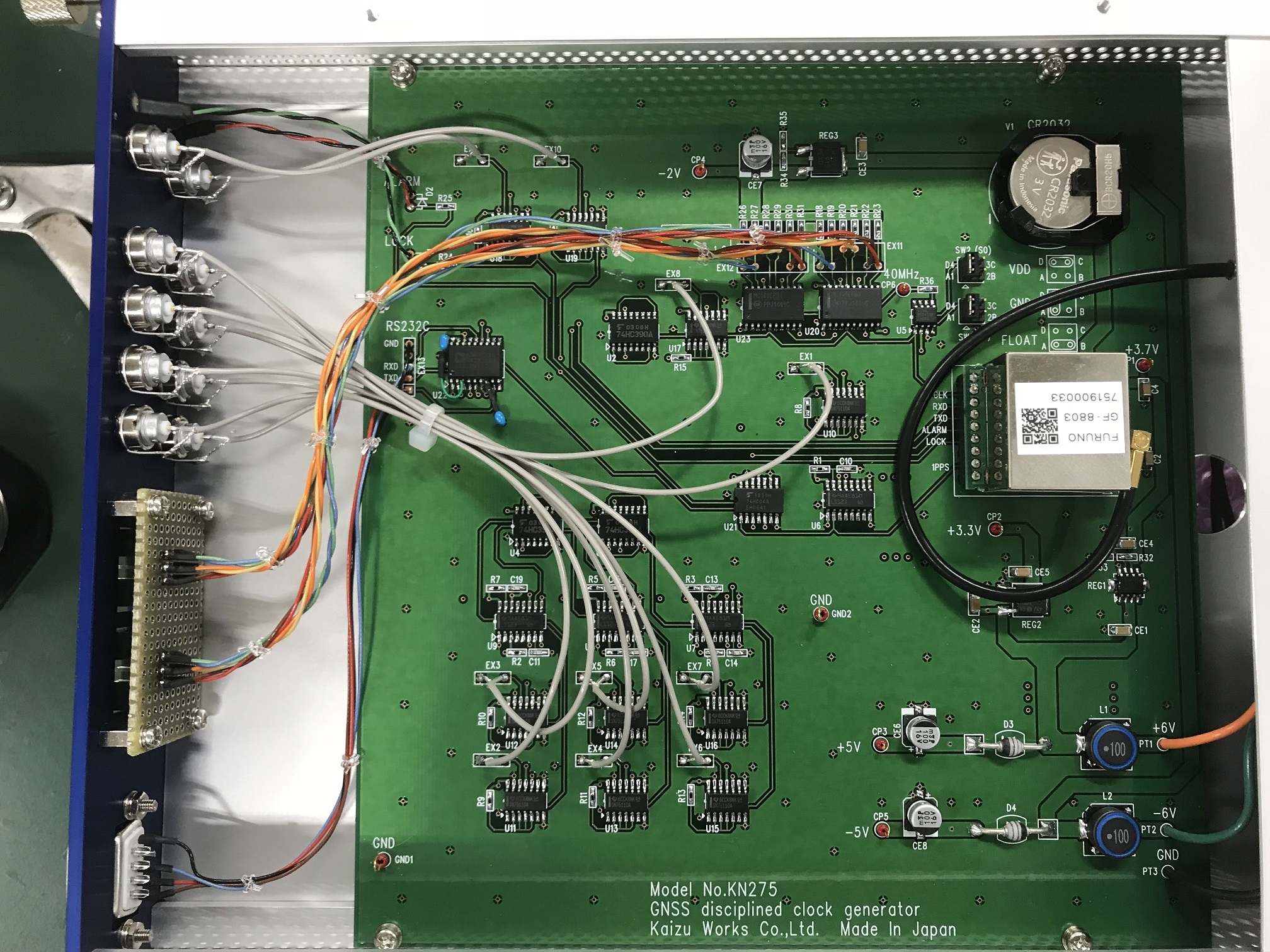
This module is equipped with a Furuno Electric GNSS module (GF-8803) and outputs high-precision 1-second pulses, 10 MHz pulses, and NMEA 0183 standard data.
When combined with a multi-hit time-to-digital converter circuit and an NTP server on a PC, it enables time recording of asynchronous signals at the microsecond order. It is used in the data acquisition system for the cosmic ray and gamma-ray observation experiment (ALPACA Project)
being conducted in Bolivia.